

An Altar Keeper’s Field Guide
A Catalog of Sacred Objects from Spiritual Traditions Around the World

It was Oscar Wilde who said, “It is only the sacred things that are worth touching.” This seems like a fitting place to begin today’s post. I spent the weekend shopping several brocantes (flea markets) in Paris. I’ve been collecting vintage rosaries to share in The Hidden Reliquary this Summer. Each rosary that I have chosen has a depth of energy and uniqueness to it - each one feels deeply sacred.
What makes an item sacred? I like to stay curious about this question. Is it the rosary itself, or the prayers infused into each bead, and the companionship in the life of each rosary?
Yesterday’s post was Part III of the Sunday series called The Art of the Altar. I shared my thoughts on the secret language of sacred objects. Any object can be a sacred object to someone: it’s about the personal value of the object.
As I finished that post I realized that I also want to share a list of more traditional sacred objects so that you have this for altar making too.
For thousands of years, humans have gathered objects around the sacred.
Some traditions call them altars.
Others call them shrines, prayer corners, household temples, ancestor tables, sacred spaces, sanctuaries, or places of devotion.
The objects themselves vary across cultures, yet many serve similar purposes. They help us remember, pray, honor, offer gratitude, connect with the divine, honor the dead, mark sacred time, and cultivate beauty.
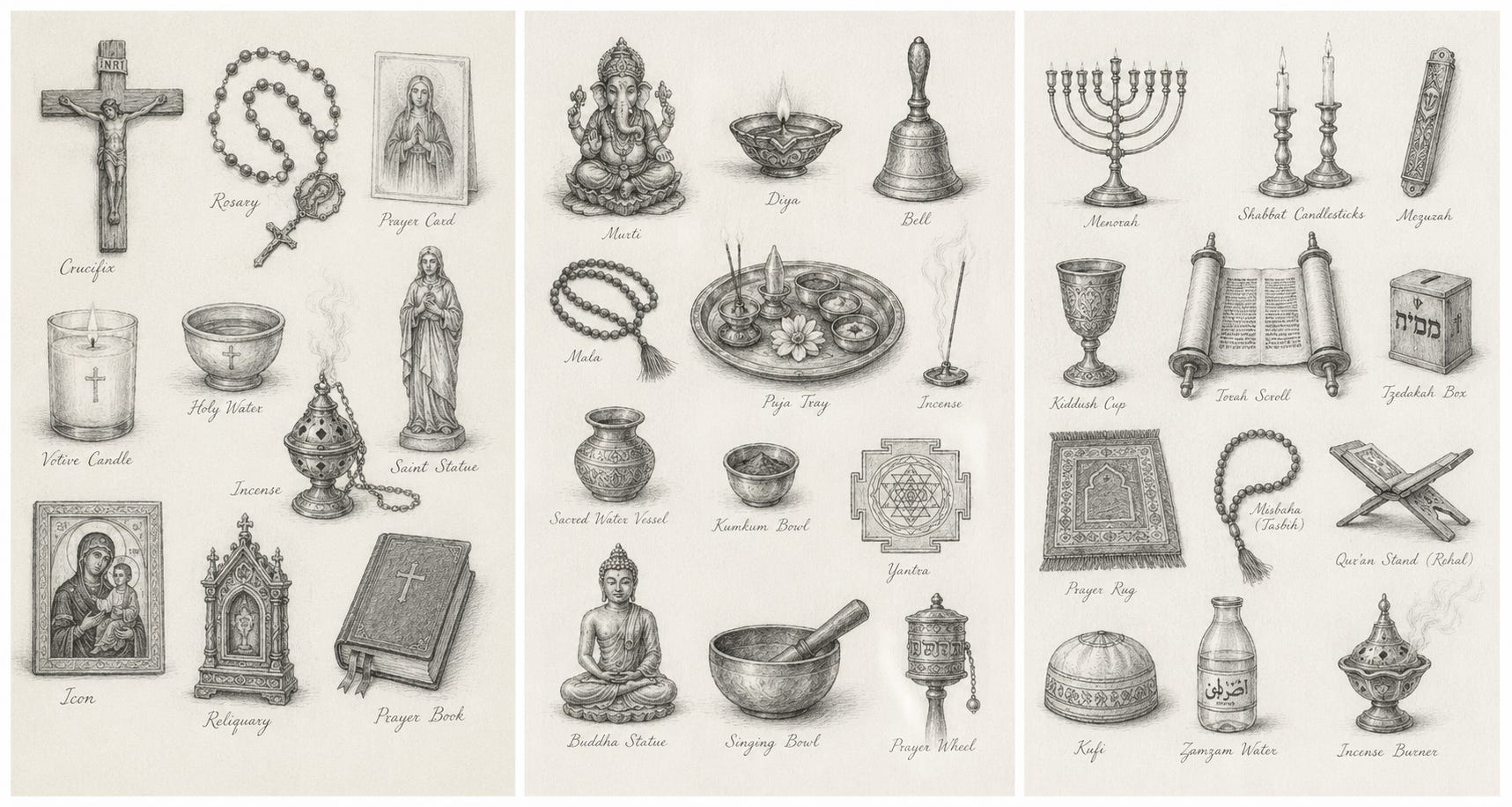
Below is a catalog of some of the most common altar objects found throughout spiritual traditions around the world, and their common uses.
CHRISTIANITY
Crucifix
A cross bearing the figure of Christ.
Used as a reminder of Christ’s sacrifice, divine love, redemption, and resurrection.
Cross
The central symbol of Christianity.
Represents faith, salvation, and the meeting of heaven and earth.
Rosary
A string of prayer beads used primarily in Catholic devotion.
Used to count prayers and meditate on sacred mysteries.
Prayer Card
Small printed cards depicting saints, Christ, Mary, or sacred prayers.
Used for contemplation and intercession.
Icon
A sacred image used especially in Eastern Christianity.
Considered a “window into heaven” rather than merely religious artwork.
Reliquary
A vessel that contains relics of saints.
Historically placed on altars to connect worshippers with holy lives.
Relic
A physical object associated with a saint.
May include bone fragments, clothing, hair, or objects touched by a saint.
Votive Candle
A candle lit as a visible prayer.
Represents intention, remembrance, or petition.
Holy Water
Water blessed for spiritual use.
Used for blessing, purification, and remembrance of baptism.
Incense
Burned during prayer and worship.
Represents prayers rising toward heaven.
Saint Statue
A sculptural representation of a saint.
Used as a reminder of holy examples and intercessors.
Prayer Book
Contains prayers, liturgies, psalms, or devotional texts.
Used for structured prayer.
JUDAISM
Menorah
A multi-branched sacred lamp.
Represents divine light and the Temple in Jerusalem.
Shabbat Candlesticks
Candles lit to welcome the Sabbath.
Mark sacred time and rest.
Mezuzah
A decorative case containing scripture.
Traditionally placed on doorposts.
Kiddush Cup
A ceremonial cup used for blessings over wine.
Used during Shabbat and holidays.
Challah Cover
Decorative cloth used to cover bread before blessings.
Represents reverence and preparation.
Tzedakah Box
A charity box.
Used to encourage generosity and sacred giving.
Siddur
Jewish prayer book.
Contains daily prayers and liturgies.
Torah Scroll
The handwritten sacred text of Judaism.
The central object of worship and study.
Havdalah Set
Includes candle, spice box, and wine cup.
Used to mark the end of the Sabbath.
ISLAM
Prayer Rug
A clean surface for daily prayer.
Orients the worshipper toward Mecca.
Misbaha (Tasbih)
Prayer beads used to recite divine names.
Often consists of ninety-nine or thirty-three beads.
Qur’an Stand (Rehal)
A wooden stand used to elevate the Qur’an.
Represents respect for sacred scripture.
Prayer Cap (Kufi)
Worn during prayer in many traditions.
Represents reverence.
Zamzam Water
Sacred water from Mecca.
Used devotionally and ceremonially.
Incense Burner
Often used in homes and sacred spaces.
Creates an atmosphere of purity and hospitality.
Calligraphic Plaque
Decorative rendering of sacred verses or divine names.
Serves as visual remembrance of God.
HINDUISM
Murti
A sacred image or statue of a deity.
Serves as a focal point for worship.
Puja Tray
Contains items used during worship.
May include flowers, incense, water, lamps, and offerings.
Diya
Small oil lamp.
Represents divine light and wisdom.
Mala
Prayer beads traditionally containing 108 beads.
Used for mantra repetition and meditation.
Bell
Rung at the beginning of worship.
Invites attention and sacred presence.
Incense Holder
Used during devotional offerings.
Represents purification and prayer.
Kumkum Bowl
Contains sacred red powder.
Used in blessings and rituals.
Sacred Water Vessel
Used for purification and offerings.
Often made of copper or brass.
Yantra
Sacred geometric diagram.
Used for meditation and spiritual concentration.
BUDDHISM
Buddha Statue
Represents awakening and enlightenment.
Used as a visual reminder of the path.
Mala
Prayer beads used for chanting and meditation.
Often contains 108 beads.
Singing Bowl
Produces resonant tones used in meditation.
Helps cultivate presence and concentration.
Butter Lamp
An offering of light.
Represents wisdom dispelling ignorance.
Incense
Offered during meditation and prayer.
Represents purification and mindfulness.
Prayer Wheel
Contains sacred mantras.
Turned as a devotional practice.
Sutra Text
Sacred teachings of the Buddha.
Used for study and contemplation.
Offering Bowls
Small bowls traditionally filled with water or offerings.
Represent generosity and gratitude.
INDIGENOUS AND ANCESTOR TRADITIONS
Because Indigenous traditions are diverse, altar objects vary significantly.
Common objects include:
Ancestor Photographs
Images of deceased family members.
Used to maintain relationship with ancestors.
Sacred Stones
Collected from meaningful places.
Represent memory, place, and continuity.
Feathers
Associated with prayer, communication, and spirit.
Used ceremonially in many traditions.
Tobacco
A traditional offering in many Indigenous cultures.
Given in gratitude and prayer.
Cornmeal
Used as an offering in numerous Native traditions.
Represents sustenance and reciprocity.
Shells
Often symbolize water, life, and ancestral connection.
Sacred Bundle
A collection of ceremonial objects.
May contain herbs, stones, feathers, or personal items.
AFRICAN DIASPORA TRADITIONS
Ancestor Glass
A glass of fresh water offered to ancestors.
Represents communication and remembrance.
White Cloth
Used to cover sacred spaces.
Represents purity and reverence.
Cowrie Shells
Associated with spiritual communication and divination.
Offering Bowl
Holds food, flowers, water, or gifts.
Used in honoring spirits and ancestors.
Sacred Images
Represent orishas, lwa, or revered ancestors.
Serve as devotional focal points.
Ritual Candles
Used in prayer, petition, and offerings.
PAGAN AND EARTH-BASED TRADITIONS
Altar Pentacle
Sacred symbol representing the elements.
Used during ritual work.
Chalice
Represents receptivity and the feminine principle.
Used ceremonially.
Athame
A ritual blade used symbolically.
Represents intention and direction.
Cauldron
Represents transformation and creation.
Used for ritual burning, herbs, and offerings.
Seasonal Symbols
Objects gathered from nature.
Represent the cycles of the year.
Crystals
Used as symbolic tools for meditation and intention.
Elemental Objects
Items representing earth, air, fire, and water.
Used to create symbolic balance.
Universal Objects Found Across Many Traditions
What fascinates me most is not the differences but the similarities.
Across centuries and cultures, people continually place the same kinds of things upon their altars:
Candles for light.
Water for purification and life.
Flowers for beauty and impermanence.
Incense for prayer and atmosphere.
Images for remembrance.
Books for wisdom.
Food, spices and precious things for offerings.
Stones for connection to place.
Objects of the beloved dead for memory.
Sacred symbols for meaning.
Treasures for devotion.
Every altar, whether Christian, Buddhist, Jewish, Hindu, Indigenous, or entirely personal, ultimately asks the same questions:
What is worthy of being remembered?
What is sacred?
And every object placed upon it becomes one possible answer. As Marianne Williamson has so beautifully stated: “What we put on the altar is then altered.”
With all that is sacred,
